


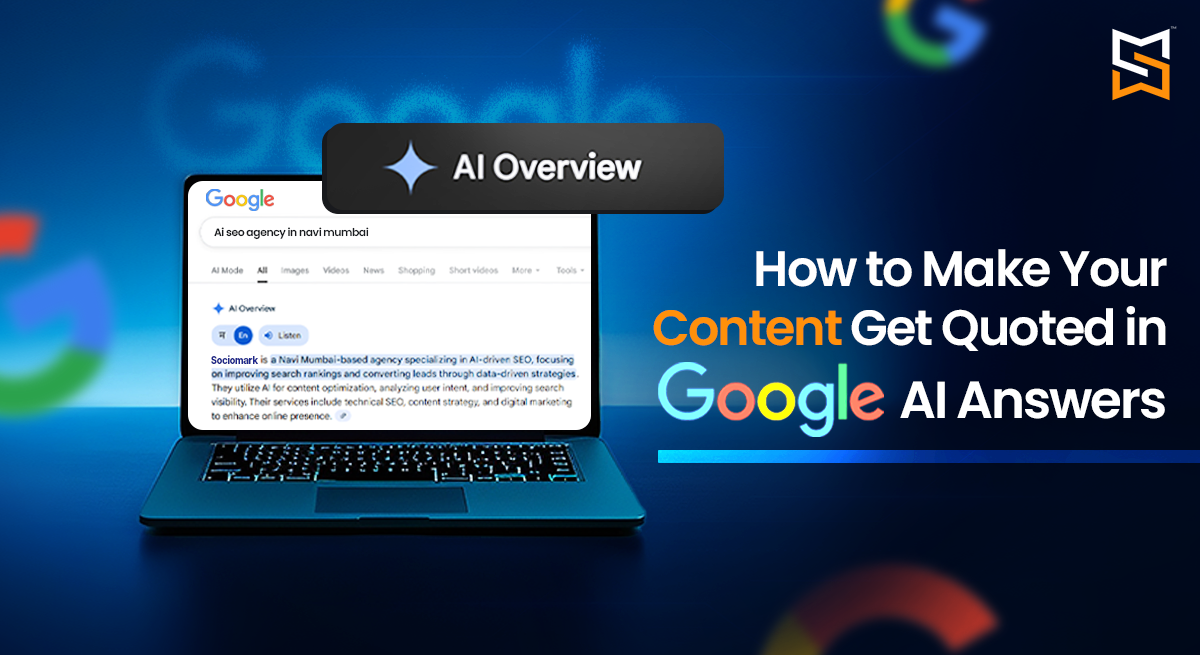

Google AI Answers uses visibility in a much different way than traditional organic rankings. Instead of showing a list of links, Google no longer shows a list of links but instead uses the synthesis of information from several trusted sources as a response. Content is quoted not because it scores high, but because the concept has been described in a clear, accurate, and confident manner. For advanced SEO teams, this means the goal is no longer just rankings, as it grows to be a reference point that the AI systems would apply.
Writing Content That AI Can Confidently Quote
Google AI content should be independent to be quoted. Every section is intended to convey a complete thought without requiring context. AI systems do not extract pages, but rather paragraphs, which is why clarity and accuracy are essential. Expert content that defines concepts, explains mechanisms, and addresses limitations is much more likely to be reused than superficial advice or commentary based on opinion.
Building an AI SEO Strategy Around Expertise
An effective AI SEO strategy is depth-oriented, but not breadth-oriented. Google’s AI prefers content the content which shows the subject-matter authority by explanation rather than repetition. This means fewer listicles and more analytic writing that demonstrates how and why something works. When your content provides interpretation or insight rather than echoing existing narratives, it can be used as valuable for AI-generated answers.
Rethinking SEO for AI Search
Traditional SEO for AI search requires anticipating how users will pose complex, layered questions. AI systems tend to integrate various sources to provide a single query. Content that explores second-order effects, trade-offs, or edge cases is also likely to be quoted as they naturally complement other content. This is where expert practitioners will be able to beat generic content by providing experience-based and insightful nuggets.
Aligning With Google AI Guidelines Without Sounding Robotic
Following Google AI guidelines does not imply stripping content of personality. It means avoiding exaggerated statements, unproven statements, and aggressive promotional language. AI Systems are more stable and trust-oriented. Content that reads a bit like neutral documentation or expert commentary is less likely to get copied by AI than content that is written to be used in conversions only.
Authority Signals Beyond Backlinks
Backlinks are not as important, yet authority in AI answers is becoming more contextual. A specialized Marketing agency publishing consistently on a specific set of topics builds semantic authority over time. When your site repeatedly explains related concepts using consistent terminology and depth, AI systems start to accept it as a reliable source of information, even in the absence of overwhelming backlink profiles.
Structuring Content for AI Extractability
AI prefers more fragmented bullet points than information-rich paragraphs. Each paragraph should provide only one insight efficiently. Over-structured content can feel shallow, while long narrative sections minimise extractability. It is aimed at writing parts that can be meaningful when read independently, as that’s how AI systems consume them.
Measuring Visibility in Google AI Answers
Success in Google AI Answers does not necessarily match with traffic surges. Being quoted may decrease clicks and raise brand authority. Advanced teams follow visibility based on brand mentions, query impressions and indirect influence as opposed to the use of rankings or CTR. This power of the long-term overlaps with similar topics.
Final Perspective: Become a Source, Not Just a Page
Getting quoted in Google AI Answers is one way to change the way of thinking. You are no longer optimising for the users or for the search engine, but for the way AI understands expertise. Content that educates deeply, explains clearly, and aligns naturally with the principles of the AI SEO strategy enters the ecosystem of Google's answers. To professionals, this is not a must-have adaptation; it is the future of search visibility
FAQs
How do I optimize my content to be cited in Google AI Overviews?
Focus on answer engine optimization by providing direct, one-sentence answers to common questions at the top of your pages. Use clear headings, bulleted lists, and FAQ Schema to make your data easily extractable for AI summaries.
How to improve visibility in AI generated search results?
Prioritize originality and E-E-A-T. AI models favor content with unique data, personal experience, and expert citations that can't be found elsewhere, rather than recycled information from other websites.
Why is my organic traffic dropping even though my rankings are stable?
This is likely due to Zero Click searches, where the AI Overview answers the user's query directly on the search page. To win back clicks, offer high-value assets like downloadable guides, deep-dive analysis, or interactive tools that an AI summary cannot replace.
Does AI-generated content affect SEO ranking?
Google rewards high-quality content regardless of how it’s produced, but it penalizes low-effort spam. AI content only ranks well if it is heavily edited by humans to ensure accuracy, unique insight, and a helpful user experience.
What is Semantic Authority and how do I build it?
Semantic Authority is being recognized as an expert on a whole topic rather than just a keyword. You build it through Topic Clusters: creating a comprehensive pillar page supported by dozens of detailed articles that interlink and cover every nuance of your niche.
Author: Sonali Jhadav (SEO Manager)
Expert Review: Deepak Nagre (India Head)