


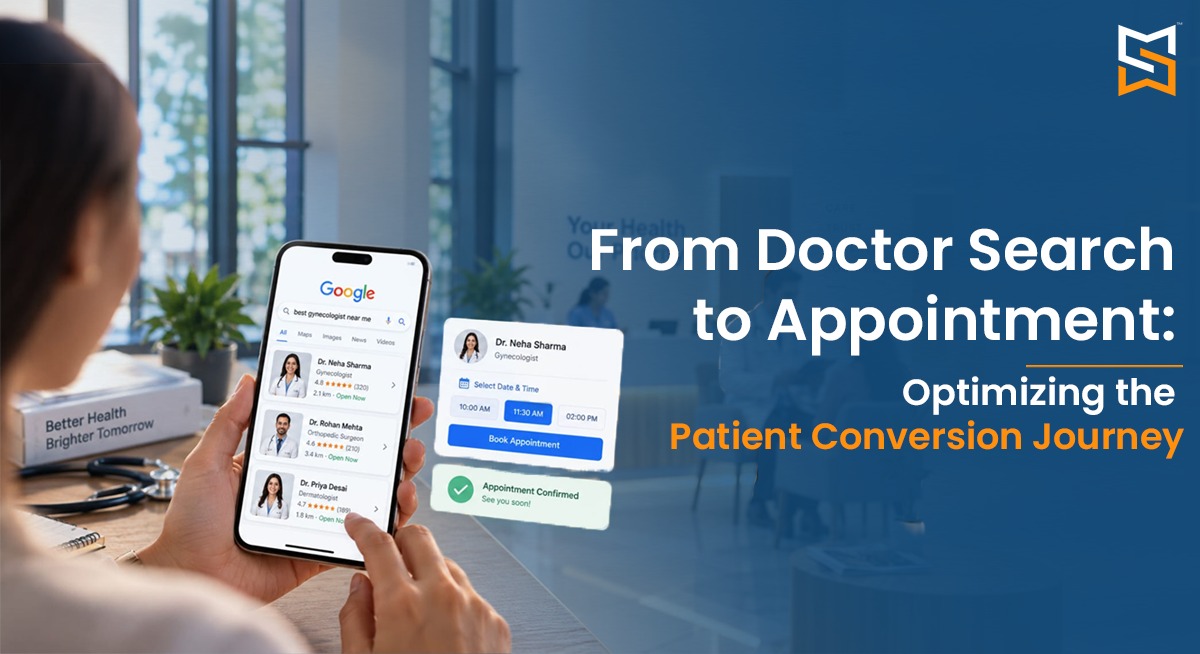

For many patients, healthcare decisions begin with an online search. Before booking an appointment, they search for a specialist, compare clinics, check reviews, or find a nearby doctor. This makes the patient conversion journey an important part of healthcare marketing. A well-optimised digital experience can support a patient throughout the journey from discovery to booking an appointment.
1. Understanding the Patient Conversion Journey
The patient’s journey can involve several stages, from the search to booking the final appointment:
Search: Patients search for a doctor, specialist, treatment, clinics, and healthcare services.
Discovery: They may discover doctor profiles, healthcare websites, or local listings.
Evaluation: They compare qualifications, experience, reviews, treatments offered, and availability.
Trust: They look for trustworthy, understandable information before deciding whether to contact or book with a healthcare provider.
Conversion: Patients may book an appointment, call the clinic, or request a consultation or contact through any other available option.
Each stage should minimise friction and make the patient journey easier.
2. Optimize Doctor Search and Discovery
Healthcare providers need to be visible when potential patients are searching for their services. The doctor profile and healthcare website must have information about speciality, experience, qualifications, services, locations, and consultation options.
For example, if someone is searching for a “dermatologist in Mumbai” or “dentist near me,” they will quickly get the details of the doctor and clinic. The use of location-based keywords, descriptive service pages, and accurate business information helps improve visibility in local and conversational searches.
3. Build Trust Before the Appointment
A patient needs to have confidence before choosing a healthcare provider. A doctor profile with information about areas of specialization, services, consultation options, experience, and qualifications can be helpful.
Patient reviews and testimonials can give another perspective on the healthcare journey. The healthcare website can enhance trust by answering frequently asked questions on educational blogs and FAQs, treatment guides, and other helpful sources. Clear and transparent information assists people in making the right choices.
4. Simplify Online Doctor Appointment Booking
A complicated booking process can cause potential patients to leave before completing an appointment. Online doctor appointment booking should therefore be simple, mobile-friendly, and easy to understand.
A user-friendly booking experience should include:
Clearly visible “Book an Appointment” buttons
Available dates and time slots
Mobile-friendly booking forms
Minimal information fields
Clear consultation fees and options
Instant appointment confirmation
The fewer unnecessary steps between selecting a doctor and receiving confirmation, the smoother the patient experience becomes.
5. Strengthen Healthcare Lead Generation
Not every website visitor is immediately ready to book an appointment. Healthcare providers can support healthcare lead generation by offering multiple ways for potential patients to connect.
These may include:
Online appointment request forms
Click-to-call buttons
WhatsApp or messaging options
Contact forms
Consultation request forms
Downloadable healthcare resources
Calls to action should also match patient intent. Someone researching a treatment may need educational information, while someone ready to consult can be directed straight to the booking page.
6. Use Local SEO and GEO to Reach the Right Patients
For clinics and healthcare providers serving specific geographical areas, local visibility is important. Google Business Profile optimization, maintaining consistent address and contact details, and creating appropriate location pages can help providers to become visible through searches such as "clinic near me" or "cardiologist in Delhi."
To connect with local patients, focus on answering their natural, location-based questions and clearly show where you offer your services. This can help search engines and AI-powered discovery tools locate the healthcare provider’s locations, speciality, and the services they offer.
7. Improve Patient Engagement After Conversion
The patient journey still does not end even after making an appointment. An effective patient engagement strategy can enhance the patient’s experience before and after the consultation.
Healthcare providers can use:
Appointment confirmations
Automated reminders
Pre-consultation instructions
Follow-up messages
Relevant educational content
Consistent communication can help to keep customers updated and make the healthcare journey more convenient.
8. Measure and Optimize the Patient Journey
Patient journey optimization needs to be continuously measured. Organic traffic, doctor-profile visits, calls, appointment requests, appointment completion, and conversions can be monitored by healthcare providers.
Such insights can identify where potential patients are dropping out. For example, high website traffic but low booking completion can be a reason for issues with making an appointment. Identifying such gaps allows the marketers to enhance the pages, CTAs, forms, and booking experiences.
Conclusion
A good healthcare digital strategy connects all the stages of the journey, starting with finding a doctor and local discovery and continuing through lead generation, building trust, online booking, and then patient engagement. Providers can make it easier for patients to move from their first search to their next step in care by combining SEO and GEO with a simple appointment experience and by offering appropriate healthcare content.
FAQs
1. What is the patient conversion journey in healthcare?
It is the journey a patient takes from searching for a doctor online to exploring healthcare information and booking an appointment.
2. How can healthcare websites improve doctor search conversions?
Healthcare websites can improve conversions with clear doctor profiles, easy navigation, relevant information, and simple appointment booking options.
3. Why is an easy appointment booking process important?
A simple booking process reduces friction and makes it easier for patients to complete their appointment requests.
4. How can SEO help healthcare providers get more appointments?
Healthcare SEO helps providers appear for relevant searches, attract potential patients, and guide them toward appointment booking.
5. How can Sociomark India help healthcare brands?
Sociomark India helps healthcare brands improve online visibility through SEO, content marketing, website optimization, and digital marketing strategies.
Author: Sonali Jadhav (SEO Head)
Review Expert: Heta Desai Baandal